Benchmark: rotation (polar motion)
This benchmark tests the rotational feedback: the polar motion excited by a surface load on a viscoelastic Earth, from the quasi-static Liouville equation (see Rotational feedback).
Load and setup
- Two axisymmetric ice loads of 10° radius centered at colatitude 25°, longitude 75°: a cap of 1500 m and a disc of 1000 m (\(\rho_\text{ice} = 931\ \mathrm{kg\,m^{-3}}\)), applied as a Heaviside load and held for 20 kyr.
- Earth model M3–L70–V01, \(C - A = 2.63\times10^{35}\ \mathrm{kg\,m^2}\).
- Grid \(\ell_\max = 128\), step 25 yr. There is no ocean load: the test drives the rotation module directly with the ice load.
Reference data and metrics
The reference is Table 14 of Spada et al. (2011), the modulus of polar motion \(|m|\) in degrees at six times. The table has two cases. The model integrates the quasi-static Liouville equation, in which the Chandler wobble is neglected, so the comparison uses the column with the Chandler wobble excluded (\(C_w = 0\)). The values are those of the normal-mode code TABOO. They are tabulated to three significant digits, which limits the comparison to about 0.4 %. VILMA1 did not contribute polar motion to this test.
The test makes three checks.
- Normalization. The rigid (2,1) inertia of each load, divided by \(C - A\), reproduces the published geometrical factor \(G\) (Spada eq. 31). This isolates the mapping from the load to the inertia tensor from the viscoelastic response.
- Love numbers. The elastic tidal number \(k^T_e\) and the secular number \(k_s\) lie in the physical range (\(0 < k^T_e < k_s\), \(0.5 < k_s < 1.5\)).
- Polar motion. \(|m(t)|\) at the six tabulated times.
Result
The numbers below are for model 1790f86 built with ifx on albedo. The model gives \(k^T_e = 0.3035\) and \(k_s = 0.9667\).
| Load | Rigid inertia \(G\) | 0 kyr | 1 kyr | 2 kyr | 5 kyr | 10 kyr | 20 kyr |
|---|---|---|---|---|---|---|---|
| cap, model [deg] | 0.01321 | 0.01617 | 0.01807 | 0.02114 | 0.02406 | 0.02920 | |
| cap, reference [deg] | 0.0132 | 0.0161 | 0.0180 | 0.0211 | 0.0240 | 0.0292 | |
| cap, difference | 0.09 % | 0.1 % | 0.4 % | 0.4 % | 0.2 % | 0.3 % | 0.0 % |
| disc, model [deg] | 0.01319 | 0.01614 | 0.01804 | 0.02110 | 0.02402 | 0.02915 | |
| disc, reference [deg] | 0.0131 | 0.0160 | 0.0179 | 0.0210 | 0.0239 | 0.0290 | |
| disc, difference | 0.41 % | 0.7 % | 0.9 % | 0.8 % | 0.5 % | 0.5 % | 0.5 % |
| tolerance | 2 % | 3 % | 3 % | 3 % | 3 % | 3 % | 3 % |
The polar motion of the cap load matches the reference to within its tabulated precision. The disc load is about 0.5–0.9 % above the reference at all times, which is the size of the difference in its rigid inertia (0.41 %) plus the rounding of the table. The disc has a sharp edge, so its (2,1) coefficient on the \(\ell_\max = 128\) grid is less accurate than that of the smooth cap.
The benchmark covers the Liouville solve for a prescribed load. The coupling of the rotational potential into the sea-level equation has no published benchmark. It is checked for consistency by test_rotation_sle (see Rotational feedback).
Figures
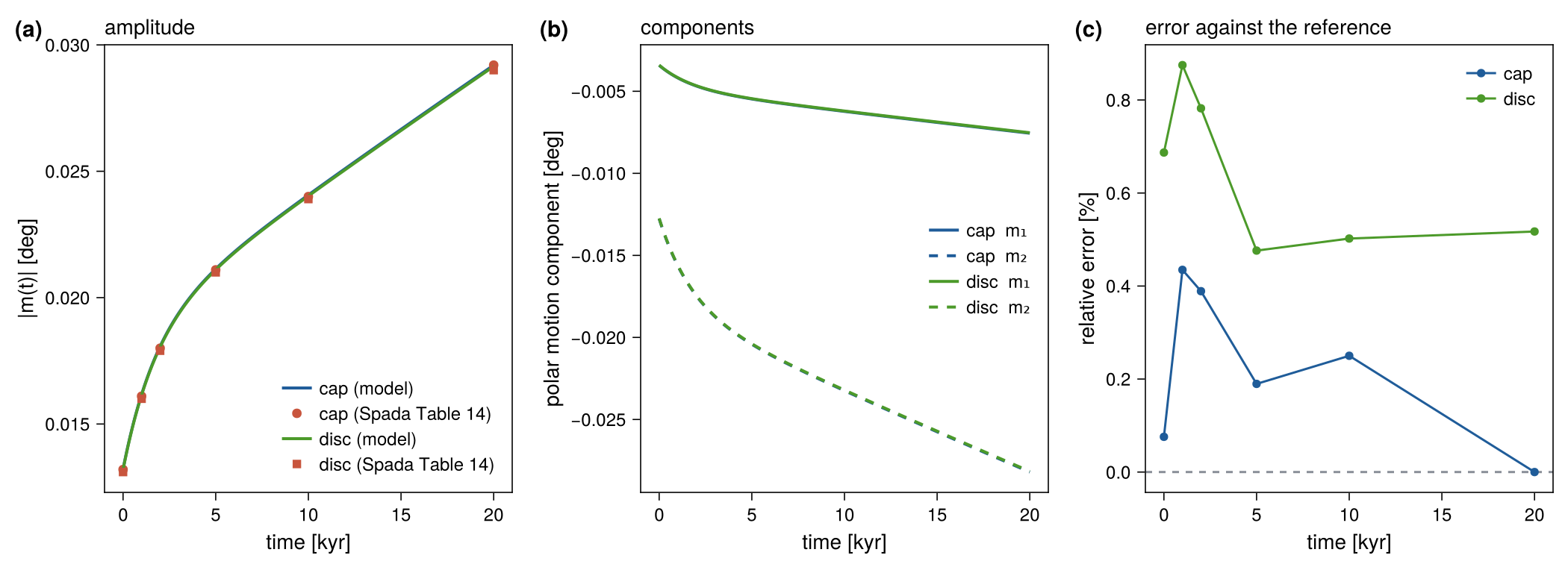
With VILMA_BENCH_DUMP set, the test writes the full trajectory (\(m_1\), \(m_2\), \(|m|\) every 25 yr) to rotation_cap_series.txt and rotation_disc_series.txt (see Benchmarks).
Provenance
Reference: data/benchmarks/rotation_spada2011/polar_motion_test3-2.txt and constants_table2.txt, transcribed from Spada et al. (2011) (Table 14 and Table 2). Full details in data/benchmarks/PROVENANCE.md.