Benchmark: Love numbers
This benchmark tests the per-degree radial solver in isolation: for a unit surface load at degree \(j\), do the elastic (instantaneous) and fluid (fully relaxed) loading Love numbers match the reference?
Earth model
M3–L70–V01 — incompressible, self-gravitating, layered Maxwell:
- a 70 km elastic lithosphere (\(\eta\to\infty\)),
- three viscous mantle layers,
- an inviscid fluid core (\(\mu=0\)).
The layer table (radius, density, shear modulus, viscosity) is the incompressible model of the Spada et al. (2011) benchmark. VILMA2’s vilma_earth_structure reproduces the benchmark’s interface gravities, total mass, and moment of inertia as an independent check before any Love number is computed.
Definitions
For a degree-\(j\) surface load of coefficient \(\sigma\), with the load’s own surface potential \(\varphi^{L} = 4\pi G\,a\,\sigma/(2j+1)\), the loading Love numbers are extracted from the surface radial functions (Farrell 1972 normalization, (Farrell 1972)):
\[ h_j = \frac{g_0(a)\,U(a)}{\varphi^{L}}, \qquad \ell_j = \frac{g_0(a)\,V(a)}{\varphi^{L}}, \qquad k_j = -\frac{F(a)}{\varphi^{L}} - 1. \]
The \(-1\) in \(k_j\) follows from Martinec’s \(\varphi_1 = F\) being the total perturbation potential, which carries the load’s direct potential with the opposite sign to \(\varphi^{L}\) (\(F\to-\varphi^{L}\) for a rigid sphere).
Analytic anchors
Two limits are exact and are checked first (test_love, to an absolute \(10^{-3}\) for the fluid limit and \(10^{-4}\) for the rigid limit):
- Fluid (\(\mu\to 0\), homogeneous): \(h_j\to-(2j+1)/3\), \(k_j\to-1\).
- Rigid (\(\mu\to\infty\)): \(h_j,\ell_j,k_j\to 0\).
The fluid limit independently exercises self-gravity, incompressibility, the Poisson coupling, and the load forcing; the rigid limit checks the shear block and the \(F\) sign.
Result
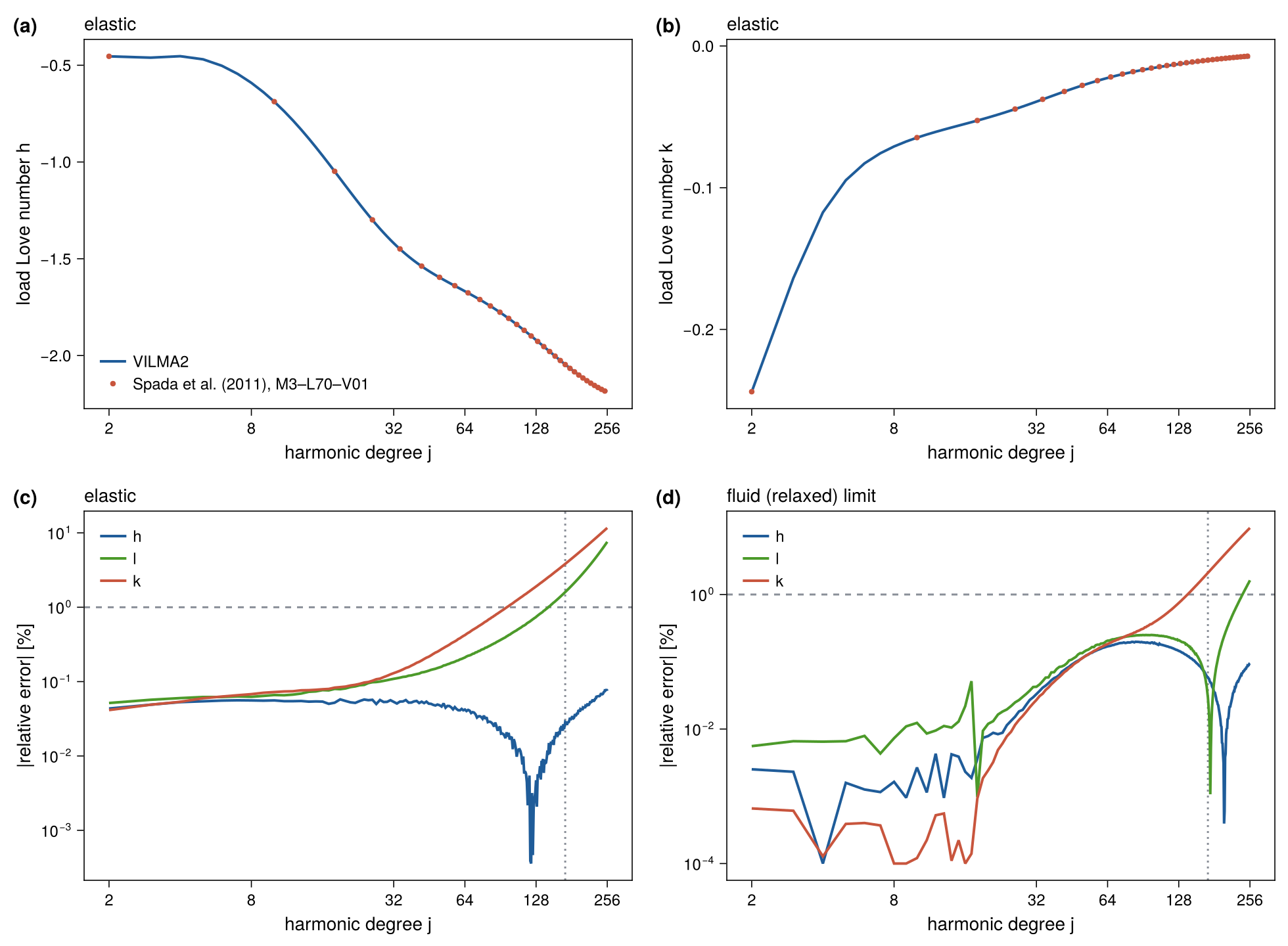
The test computes \(h\), \(\ell\) and \(k\) at every degree from 2 to 256 for the elastic and the fluid limit, and compares them with the reference table. It asserts agreement within 1 % only over the degree ranges given above. The table below gives the largest relative error measured in each degree band (model 1790f86, ifx, albedo).
| Limit | Number | 2–8 | 2–48 | 49–96 | 97–144 | 145–200 | 201–256 |
|---|---|---|---|---|---|---|---|
| elastic | \(h\) | 0.06 % | 0.06 % | 0.05 % | 0.02 % | 0.04 % | 0.08 % |
| elastic | \(\ell\) | 0.06 % | 0.15 % | 0.41 % | 1.0 % | 2.8 % | 7.6 % |
| elastic | \(k\) | 0.07 % | 0.25 % | 0.99 % | 2.5 % | 5.9 % | 11.7 % |
| fluid | \(h\) | 0.003 % | 0.10 % | 0.20 % | 0.19 % | 0.11 % | 0.10 % |
| fluid | \(\ell\) | 0.008 % | 0.13 % | 0.25 % | 0.25 % | 0.25 % | 1.6 % |
| fluid | \(k\) | 0.001 % | 0.10 % | 0.35 % | 1.1 % | 3.9 % | 9.8 % |
The vertical Love number \(h\) matches the table to better than 0.1 % (elastic) and 0.2 % (fluid) at every degree. The low degrees, which carry most of the GIA signal, match to better than 0.1 % in all three numbers. Correct discretization of the self-gravity \(U\)–\(F\) block is essential for the low-degree elastic numbers (see the typo in Martinec (2000) eq. (81)).
The relative error of \(\ell\) and \(k\) grows with degree. The elastic \(k\) first exceeds 1 % at degree 97 and reaches about 12 % at degree 256, and the elastic \(\ell\) first exceeds 1 % at degree 145. Both numbers decay with degree (\(|k| < 0.016\) and \(|\ell| < 0.0021\) above degree 96), so the absolute differences stay small: at most \(8\times10^{-4}\) in \(k\) and \(2\times10^{-5}\) in \(\ell\). The difference in \(k\) is nearly the same in the elastic and the fluid limit and grows roughly as the square of the degree. It is therefore independent of the rheology. It is a discretization error of the radial mesh, not a limit of the reference: halving the element size reduces the error at degree 256 from 11.7 % to 3.0 % in \(k\) and from 7.6 % to 2.0 % in \(\ell\), and halving it again to 0.8 % and 0.5 % (second-order convergence; see the mesh convergence table). At the default mesh (5 km elements above 70 km depth) the short-wavelength \(k\) and \(\ell\) are thus resolved to about 1 % up to degree 96 and 144. A finer mesh (mesh_dr_scale < 1) improves them at a cost proportional to the number of elements.
The practical consequence is limited to the geoid at short wavelength. The bedrock displacement, which dominates relative sea level, depends on \(h\). The geoid contribution of a degree above 96 is scaled by \(1 + k\), which the difference changes by less than 0.1 %.
TABOO (NV=3, CODE=7) served as an independent reference to regenerate the M3–L70–V01 table.
Figures
The full comparison table can be written by the test itself: set VILMA_BENCH_DUMP to an existing directory and the test writes love_elastic.txt and love_fluid.txt there (see Benchmarks).
Provenance
Reference table: data/benchmarks/love_M3-L70-V01/mod_M3-L70-V01, from the giapy package (MIT) [S. B. Kachuck], originating in the Charles University GIA benchmark; independently regenerable with TABOO (GPLv3). Full details in data/benchmarks/PROVENANCE.md.