Benchmark: low-viscosity zone (lateral viscosity)
This benchmark tests the laterally varying viscosity against published results of three-dimensional finite-element codes. It is the only test of the 3-D path against codes other than VILMA1.
Load and setup
- Earth model M3–L70–V01.
- An axisymmetric ice disc of 100 km radius (\(\rho_\text{ice} = 931\ \mathrm{kg\,m^{-3}}\)). Its height grows linearly from 0 to 100 m over 100 yr and is then held to 200 yr.
- A cylindrical low-viscosity zone (LVZ) under the load: radius 100 km, depth 70–170 km, viscosity \(10^{19}\) Pa s in an upper mantle of \(10^{21}\) Pa s. The shear modulus is unchanged.
- Two runs: the homogeneous model (no LVZ) and the model with the LVZ.
The load and the LVZ are axisymmetric, so the problem has order \(m = 0\) only. The test runs with mmax = 0 at \(\ell_\max = 512\) (a shortest half-wavelength of about 40 km, against the 100 km radius of the disc) with a step of 2.5 yr. It drives the viscoelastic response with the ice load directly. There is no ocean and no sea-level equation.
Reference data and metrics
The reference values are the vertical surface displacement at the load center at \(t = 200\) yr: \(-0.75\) m for the homogeneous model and \(-1.23\) m with the LVZ. The published codes differ among themselves. ASPECT and Abaqus agree to 1–3 %. ASPECT, which has no self-gravity, and TABOO, which has, agree to 0.3 % at the load center of the homogeneous model. Self-gravity is thus a sub-percent effect in this case, and the published numbers are a valid reference for a self-gravitating spherical model to within a few percent. The tolerance of the test is 8 %.
Result
The numbers below are for model 1790f86 built with ifx on albedo.
| Case | VILMA2 | Reference | Difference | Tolerance |
|---|---|---|---|---|
| homogeneous | \(-0.731\) m | \(-0.75\) m | 2.6 % | 8 % |
| with LVZ | \(-1.218\) m | \(-1.23\) m | 1.0 % | 8 % |
| amplification by the LVZ | 1.67 | 1.64 | 1.6 % | not asserted |
VILMA2 reproduces the displacement with the LVZ to 1 % and the homogeneous displacement to 2.6 %. Both differences are within the 1–3 % spread of the published codes. The low-viscosity zone increases the displacement by a factor of 1.67, against 1.64 in the reference.
The scope of this benchmark is limited. It compares one number per run, the displacement at the load center, on a time scale of 200 yr. It has a single order (\(m = 0\)), so it does not exercise the coupling between orders or the toroidal flow, which vanishes for an axisymmetric problem. The rotational-invariance test test_rotinv complements it: the same kind of load and LVZ placed away from the pole gives the peak displacement of the on-pole case to 0.5 % at \(\ell_\max = 128\) (tolerance 1 %, in make check-slow). A comparison of the 3-D path at glacial time scales exists only against VILMA1.
Figures
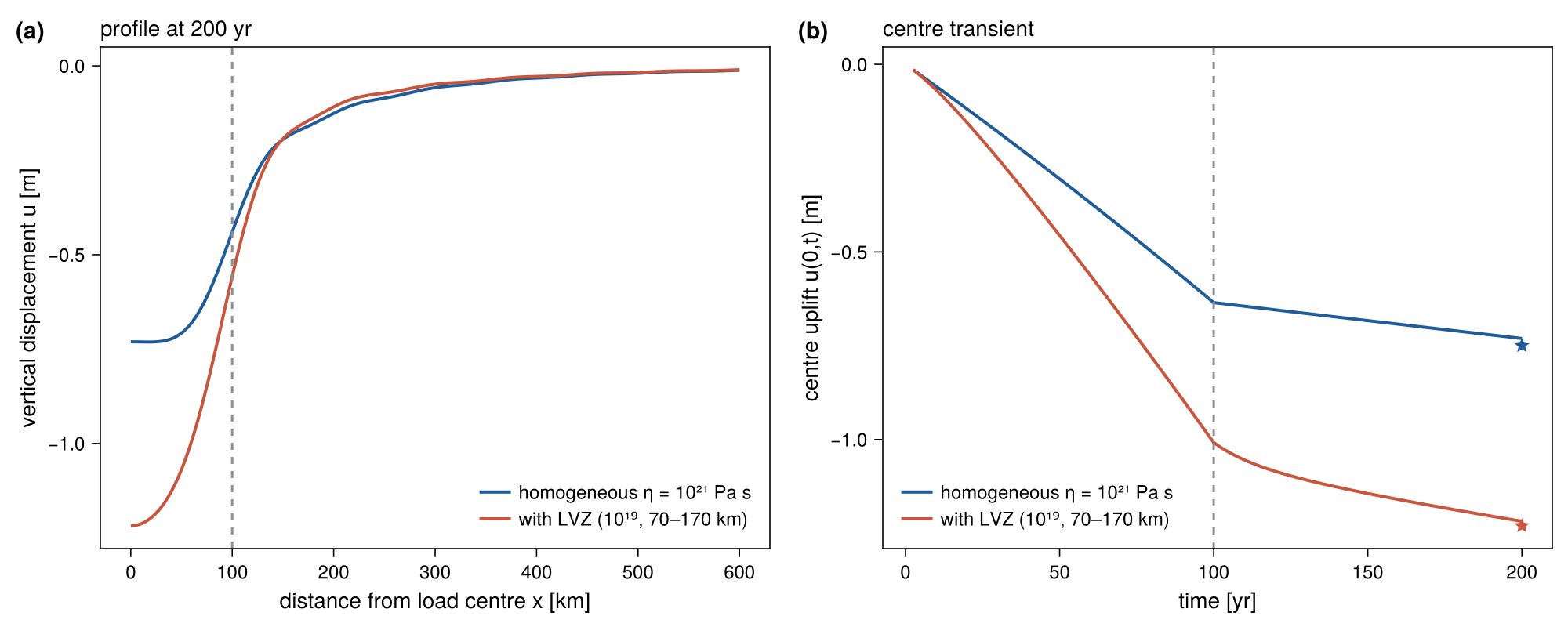
With VILMA_BENCH_DUMP set, the test writes the center displacement against time and the profile at 200 yr of both runs (lvz_homog_series.txt, lvz_homog_profile.txt, lvz_lvz_series.txt, lvz_lvz_profile.txt); see Benchmarks.
Provenance
The reference values are quoted from Weerdesteijn et al. (2023) (their section 5.2 and Table 4). No reference data file is needed.