Benchmark: disc-load response
This benchmark integrates the per-degree response over a spatial load and adds the time relaxation, testing the spatial synthesis and the Maxwell stepper together against a spatial reference.
Load and setup
- A 10° radius disc of 1000 m ice (\(\rho_{\text{ice}} = 931\ \mathrm{kg\,m^{-3}}\)) on elevated bedrock — no ocean load.
- Earth model M3–L70–V01 (as for the Love numbers).
- The disc is expanded in Legendre coefficients \(\sigma_n = \tfrac{\sigma_0}{2}\,[P_{n-1}-P_{n+1}]\) and the spatial response is synthesized as \(u(\theta) = \sum_n U_n(a)\,\sigma_n\,P_n(\cos\theta)\).
Reference data and metrics
The reference is the spatial response at colatitudes \(\theta = 0\):\(0.1\):\(20°\) (201 points) and times \(t = [0,1,2,5,10,100]\) kyr (column 1, \(t=0\), is the elastic response). The reference provides three fields: vertical displacement \(u\), geoid \(n\), and uplift rate \(\mathrm{d}u/\mathrm{d}t\). The stored curves are piecewise linear on a 1° grid, which limits how closely any smooth solution can match them (see data/benchmarks/PROVENANCE.md).
The test makes two comparisons.
- Elastic profile. \(u(\theta)\) and \(n(\theta)\) at \(t=0\) over the full colatitude range, from the per-degree elastic response summed to degree 256. The error is the largest absolute difference divided by the peak of the reference profile. A band of ±1° around the disc edge is excluded from the assertion, since a truncated spectral sum rings at the discontinuity of the load (Gibbs). The error in that band is reported.
- Viscoelastic center uplift. \(u(0,t)\) at \(t = 1, 2, 5, 10\) kyr, from the 1-D Maxwell stepper summed over degrees 2–128 with a 20 yr step.
The test does not compare the uplift rate \(\mathrm{d}u/\mathrm{d}t\), the viscoelastic profile away from the center, or the response at \(t = 100\) kyr. The 100 kyr response is left out because the fluid-limit disc sum of the model lies about 2.6 % below the reference, which is within the scatter of the benchmark codes but has not been resolved. The viscoelastic profiles are written to the dump files for inspection.
The reference uses a mixed reference frame: displacement in a center-of-figure-like gauge (\(h_1\approx 0\)) and geoid with \(N_1 = 0\). VILMA2 reproduces it with deg1_frame = "cf", which keeps the solver’s displacement gauge and drops the degree-1 geoid. The default "cm" frame differs from the reference at degree 1 only (see Sea-level equation).
Result
The numbers below are for model 1790f86 built with ifx on albedo.
| Quantity | Tolerance | Measured |
|---|---|---|
| Elastic uplift profile, off-edge | 6 % of peak | 4.0 % (0.83 m of 20.57 m, at \(\theta = 18°\)) |
| Elastic geoid profile, off-edge | 4 % of peak | 2.8 % (0.93 m of 33.05 m) |
| Elastic uplift, edge band ±1° | reported only | 1.22 m |
| Center uplift at 1 kyr | 3 % | 0.23 % (\(-69.96\) m, reference \(-70.12\) m) |
| Center uplift at 2 kyr | 3 % | 0.56 % (\(-105.25\) m, reference \(-104.66\) m) |
| Center uplift at 5 kyr | 3 % | 0.02 % (\(-166.19\) m, reference \(-166.22\) m) |
| Center uplift at 10 kyr | 3 % | 0.17 % (\(-202.66\) m, reference \(-203.01\) m) |
The center uplift of the viscoelastic transient matches the reference to better than 0.6 % at all four times. The elastic center uplift at \(t=0\) in the same sum (degrees 2–128) differs by 0.5 % (\(-20.67\) m, reference \(-20.57\) m) and is reported but not asserted. The largest off-edge difference of the elastic uplift profile is in the far field at \(\theta = 18°\), where the signal itself is small. The elastic profile tolerances are therefore loose compared with the Love-number agreement: they bound the Gibbs ringing of the truncated sum and the 1° sampling of the reference, not the per-degree response.
Figures
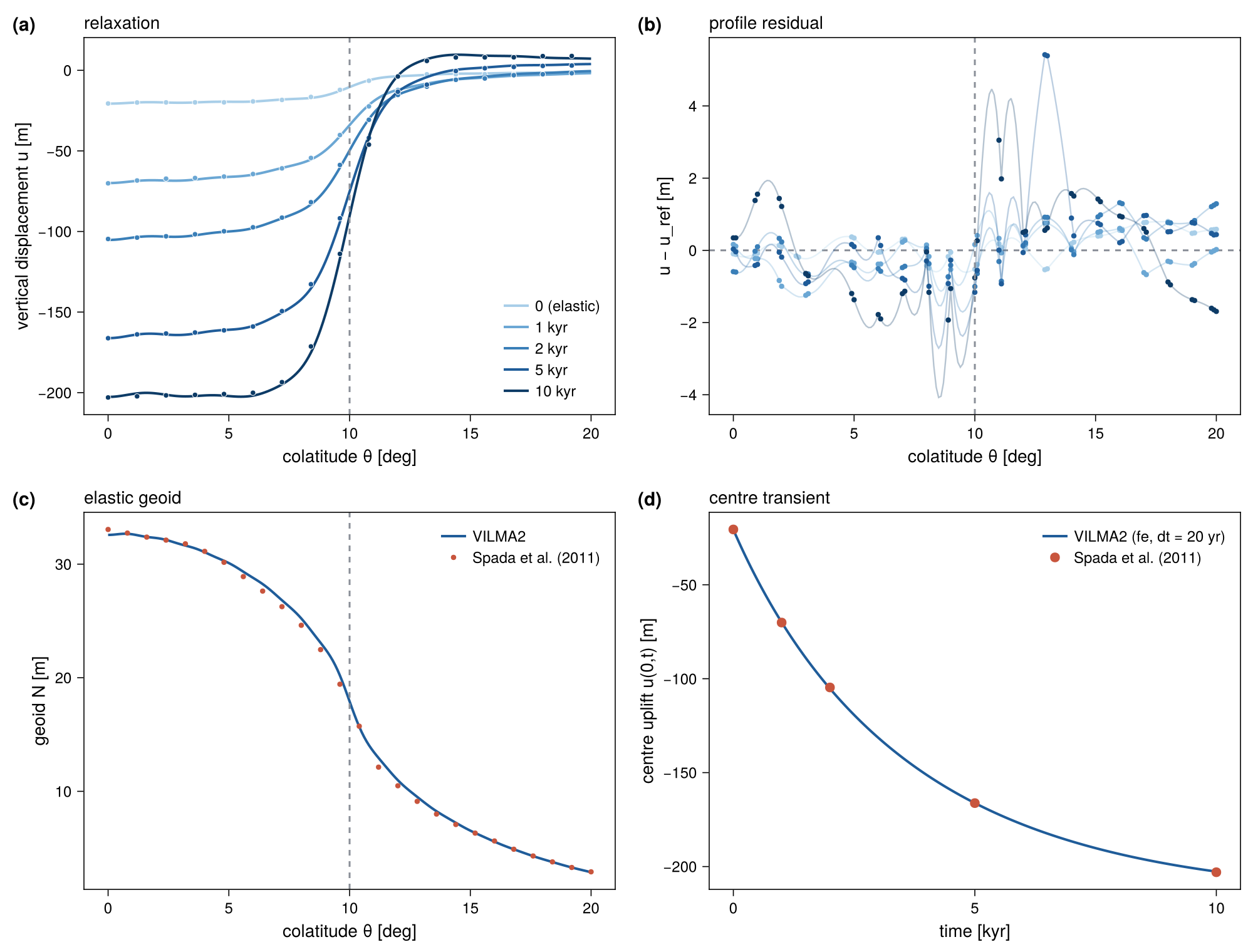
With VILMA_BENCH_DUMP set, the test writes disc_elastic_profile.txt, disc_ve_profile.txt and disc_ve_centre_series.txt (see Benchmarks).
Provenance
Reference: data/benchmarks/disc_spada2011/{u,n,dudt}_disc.txt, from the isostasy_data repository [J. Jereczek], model_outputs/Spada-2011/, originating in the Spada et al. (2011) benchmark. Full details in data/benchmarks/PROVENANCE.md.