column
The Nye analytic ice-divide benchmark — test_column.x
What it tests
test_column.x is elsa’s end-to-end quantitative check. The full pipeline — namelist, init, mass balance, normalization and layer insertion — is exercised at an ice divide, where the answer is known in closed form.
At a divide there is no horizontal flow. For constant ice thickness \(H\) and constant accumulation \(a\), an isochrone laid down at the surface sinks under uniform vertical strain. Nye’s steady-state solution places it, after elapsed time \(\tau\), at a height above the bed of
\[ z(\tau) = H\,\exp\!\left(-\frac{a\,\tau}{H}\right). \]
Source: src/test_column.f90. Run it with make run-column.
Vertical motion is emergent
elsa never computes a vertical velocity. Each coupling step it adds \(a\,\Delta t\) to the top layer and renormalizes the column onto \(H\), which multiplies every layer height by \(r = H/(H + a\,\Delta t)\). After \(n = \tau/\Delta t\) steps,
\[ z = H\,r^{\,n} = H\left(1 + \frac{a\,\Delta t}{H}\right)^{-\tau/\Delta t} \;\longrightarrow\; H\,\exp\!\left(-\frac{a\,\tau}{H}\right) \quad\text{as } \Delta t \to 0. \]
The vertical thinning is therefore a consequence of the layer bookkeeping, rather than something imposed. The benchmark checks two separate things: that elsa lands on the discrete recursion \(H\,r^n\) exactly (a statement about the code), and that this converges onto the analytic Nye profile at first order in the coupling period (a statement about the scheme).
Results
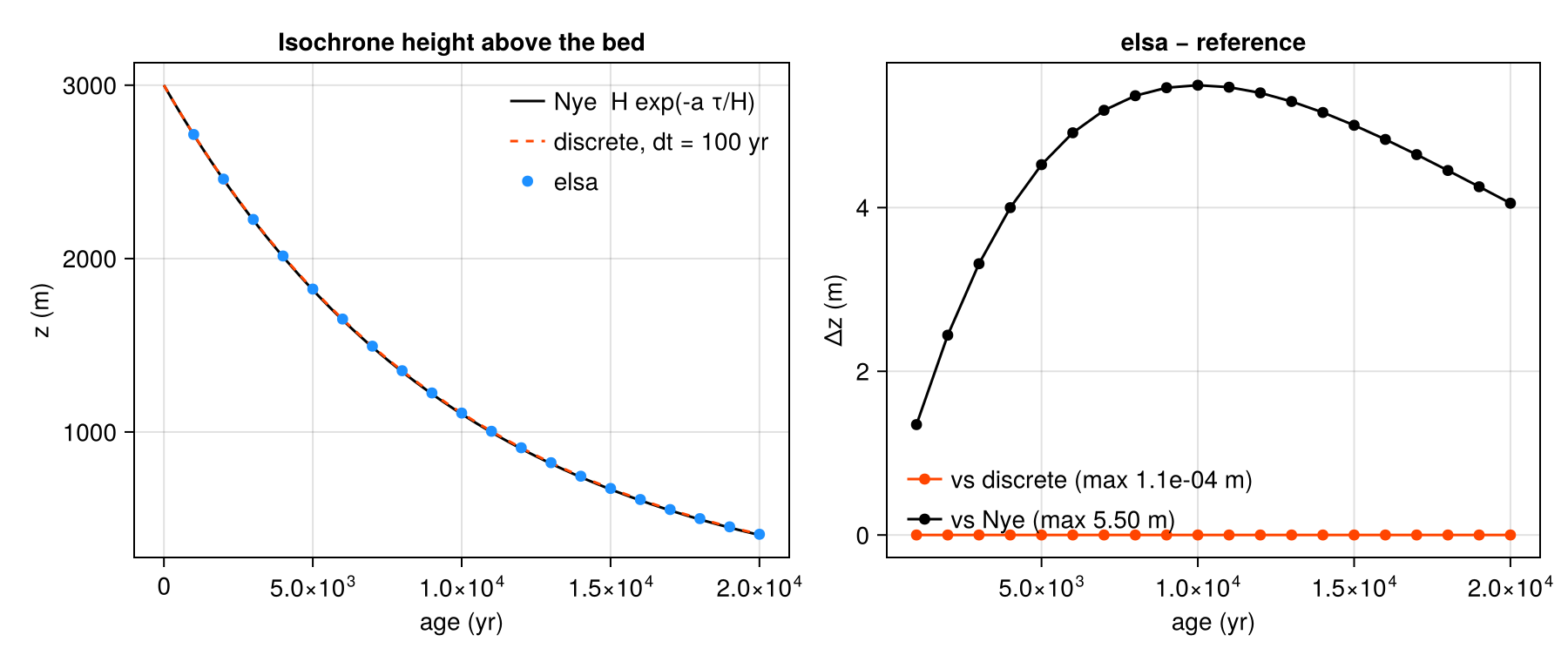
- Against the discrete recursion: exact. All 20 isochrones land on \(H\,r^n\) to a relative error of \(4.9\times10^{-15}\) — machine precision on the in-memory double-precision state.
- Against Nye: first-order. At \(\Delta t = 100\) yr the maximum departure is around 5.5 m out of 3000 m of ice, and halving \(\Delta t\) halves this departure. The convergence ratios measured at \(\Delta t = 200, 100, 50\) yr are 1.997 and 1.998, against a first-order expectation of 2.
The shape of the residual in the right panel — zero at the surface, zero at the bed, and a smooth bump in between — is consistent with a discretization error rather than a bug.
Restart, in passing
The same benchmark asserts that elsa_end followed by a second elsa_init on the same object succeeds. v2.0 freed only seven of its nine arrays, so the second init aborted on an already-allocated array, which is why v2.0 could not restart. The bit-identical restart round-trip is checked in greenland.